
About Seaweed
Seaweed
Harness the natural healing power
About Seaweed
Did you know that...
- Algen 75% des jährlichen Pflanzenwachstums unserer Erde einnehmen?
-
Algae supply up to 90% of our planet's total oxygen production?
- Could algae possibly supply 80% of the food intake for the entire world population?
- Algae can filter seawater, and thus concentrate the riches of the sea 100 to 1000 times?
- that algae contain well over 80 health-promoting elements?
- no other natural product is as rich in minerals, trace elements, vitamins, and amino acids as algae.
- smallest algae consist of only one cell, and giant kelp algae can grow over 100 meters long?
- that algae have no roots or leaves, and bear no fruits or flowers?
- takes up about 70 % of the Earth's surface?
- The oxygen-nitrogen ratio of air is 21:79, but that of seawater is 35:65? So water contains relatively much more oxygen than air!
Macro- and micro-algae
(Spirulina, Chlorella, Blue-Green Algae, Sea Brown Algae)
Macroalgae are multicellular seaweeds that form a „true“ plant. They have a stem and leaves. Depending on the water depth, they are brown, red, or green.
Seaweed attaches itself to rocks with its „root“ and is completely surrounded by seawater. There are approximately 4,000 different types of seaweed, but few are used for human consumption. Seaweed contains valuable nutrients, but above all a wealth of trace elements, including the iodine that is so important for us.
Another important plant ingredient is algin, which is used today for many purposes, including food production. These algae contain iodine, which is so important for us.
Microalgae are different. They are single-celled algae. Spirulina, Chlorella, or blue-green algae are popular representatives of this type. They are usually cultivated in freshwater tanks (soda water).
The „algal bloom“ that drifts in coastal regions during certain seasons also belongs to microalgae.
Seaweed as food
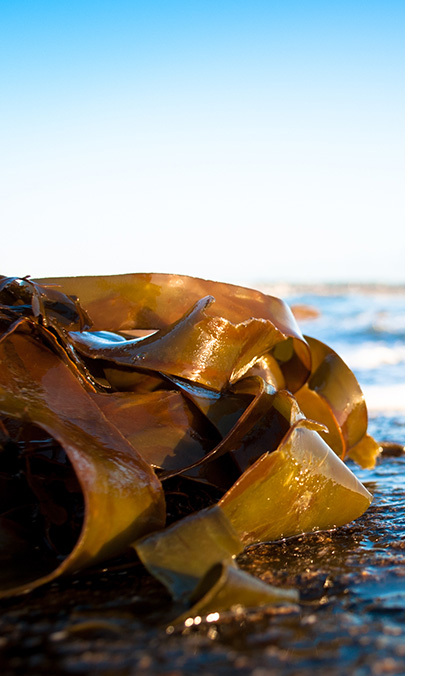
Seaweed is highly valued in Asia – particularly in China, Korea, and Japan – as a delicacy and source of minerals. However, seaweed dishes are an unusual culinary experience (even for us Germans) and require some getting used to in terms of taste. Protein- and vitamin-rich types of seaweed have always been incorporated into the diets of coastal dwellers on almost all continents.
Your iodine content is an important nutritional aspect. In South America (for example, along the entire Chilean coast), Ulva and Durvillea species are collected, dried, salted, and sold as Cachiyugo. On the west coast of Ireland, the two red algae Rhodymenia pseudopalmetta and Chondrus crispus (Irish Moss) are sold in grocery stores.
In Scotland, seaweed bread is commercially available. And Irish moss pudding is still one of the Irish national dishes today. Similarly, seaweed from the Breton coast in France is part of the daily diet, whether as seaweed soup, seaweed bread, seaweed teas, or seaweed capsules. Mostly, the brown seaweeds Laminara, Fucus vesiculosus, or Ascophyllum nodosum are used.
Seaweed holds by far the greatest significance as a foodstuff in China, Korea, and Japan. The best-known products are marketed in Japan under the names Nori, Kombu, Wakame, and Dulse.
Nori = Red Algae Porphyra: Preparation for Delicious Sushi
Kombu = Brown algae Laminaria, Ascophyllum nodosum: Soups, fillings
Wakame = Brown Algae Undaria pinnatifida: Miso Soups
Dulse = red algae: salads, soups
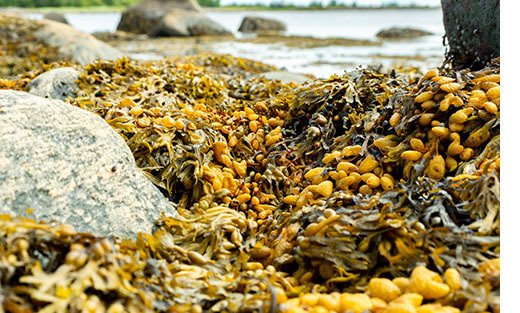
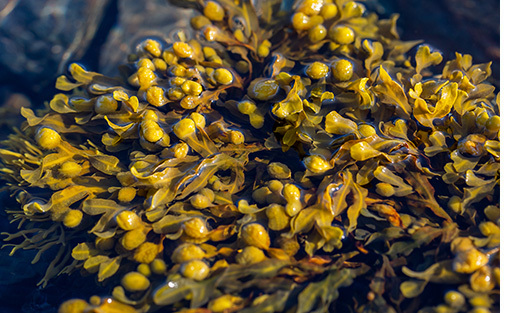
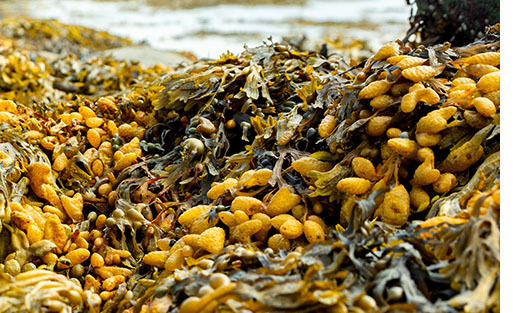
A Seaweed on the Rise: Of all algae species, the brown seaweed Ascophyllum nodosum is the most significant due to its high nutritional value and health-promoting ingredients. It grows wild in the North Sea on rocky substrates. It is a plant with a slender stem, small leaves, and very many „knots“ (hence also called knotweed).
It is very suitable for soups. Furthermore, it optimizes almost all the positive properties of other seaweeds and is therefore often used as a dietary supplement (algae capsules).
Knotted wrack
Ascophyllum nodosum is a wild-growing macroalgae that can grow up to several meters long. This brown algae grows on various rocky coastal areas in the temperate climate zone. This region is also home to the lobster, which is a reliable indicator of water quality, as it would not be able to survive in polluted water.
Algae can be composed of well over 80 individual components.
The waters of the North Atlantic flow through ancient rock formations on their way to the Canadian East Coast, containing valuable minerals that are so important to us as trace elements. The algae are capable of enriching the trace elements in their cells. The trace elements are “biologically energized,” so to speak, by the process of passing through the cell membrane. Some elements are able to pass through the cell membrane as they are, others must, for example.
Amino acid complexes are formed to enter the cell. Through this preparation, the trace elements also become better absorbed, meaning they are more usable, by humans.
This explains why Ascophyllum nodosum is superior to microalgae for the supply of trace elements and micro-trace elements.
In addition to trace elements, the iodine content of Ascophyllum nodosum plays an important role for people in Germany, Austria, and Switzerland.
The intake of iodine through food is essential. The iodine content of fresh algae, as a vegetable, can vary greatly.
The problem is not a supposedly high amount of iodine, but the sudden availability of this amount. The Japanese, for example, are used to much higher amounts of iodine than we are. Incidentally, the Japanese population has a particularly high life expectancy, which is not to say that this is due to iodine intake; but if a high iodine intake were a health problem, this would contradict the above-average life expectancy.
| Ascophyllum nodosum [%] | Spirulina [%] | Chlorella [%] | |
|---|---|---|---|
| Protein | 6 | 58 – 70 | 33 – 45 |
| Carbohydrates | 52 | 13 – 19 | lower molar. Sacch. < 1 |
| Fats/Fatty acids | 2 | 5 – 8 | 7 – 16 |
| Dietary Fiber Roughage | 18 | 8,5 | 7 |
| Minerals | 22 | 3 – 8 | 6,5 – 10,5 |
The specified values are means.
They essentially vary due to biological scatter.
Daily recommended intake:
Ascophyllum nodosum: 1 g
Chlorella: 3 g
Spirulina: 3 – 4 g
For the substitution of trace elements and micro-trace elements, as well as iodine, and for the detoxification of toxic heavy metals – especially mercury and cadmium – is reported from Ascophyllum nodosum. Compared to microalgae, a significantly smaller amount is required, so the price per daily dose remains at a comparable level.